AI Turns Senior Devs into Junior Devs
The Documentation Desert
When you learned to code, there were textbooks. Style guides. Stack Overflow threads from 2009 explaining exactly why your regex was failing. With agentic coding, that foundation doesn’t exist yet.
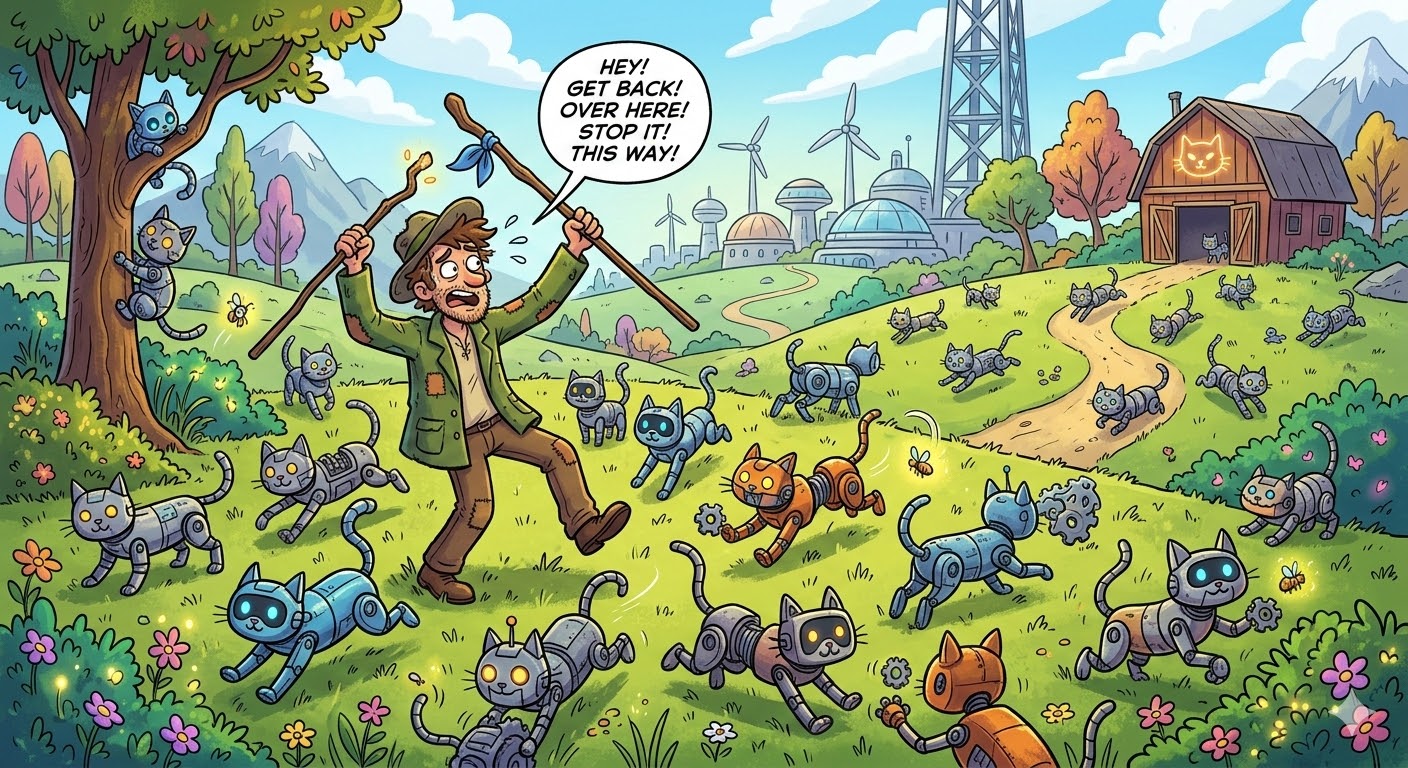
We’re cobbling together workflows from Twitter threads, Discord screenshots, and half-finished READMEs. One team swears by chain-of-thought prompting; another insists you must never let the agent see the tests first. Some tools demand micromanagement; others crumble under too much direction. The worst part? These techniques often conflict. The prompt structure that makes Claude sing sends GPT into hallucination spirals, and what works in Cursor dies in Windsurf.
It’s not just messy - it’s actively hostile to muscle memory. Yesterday’s best practice becomes today’s anti-pattern when the model updates overnight.
The Beginner’s Mind (Whether You Want It or Not)
Think back to your first production bug. You made assumptions about how the database worked. You didn’t know the build system. Your code “worked” but violated every architectural principle the team cared about. You were slow, frustrated, and constantly aware that you were missing something obvious.
Now watch a senior engineer open their first agentic coding session.
They’re making the exact same category of errors - just dressed up in sophistication. They assume the AI understands their monorepo structure because they understand it. They trust the agent to handle auth because “it’s just plumbing.” They watch the AI generate 500 lines of “working” code that ignores the team’s established error-handling patterns entirely.
The output isn’t just buggy; it’s naive in the specific way only beginners are naive. It doesn’t know what it doesn’t know about your stack, your constraints, or that one weird quirk in your legacy API from 2018.
Frontier Shock
Here’s what makes this harder than being a junior: when you’re new to the industry, there’s a safety net. Mentors, code reviews, established patterns. With agentic coding, everyone is equally lost.
Knowledge transfer is nearly impossible because the parameters keep shifting. The prompt that saved you three hours last Tuesday now triggers a different behavior because the model was updated. The context-window management strategy you perfected for one codebase asphyxiates on another because of token count differences. You can’t mentor someone when the ground rules change weekly.
Worse, seniors carry baggage. They’ve spent fifteen years optimizing for speed - skipping docs because “the code is the documentation,” hand-waving tests because “I know this works.” Agentic coding punishes those shortcuts brutally. The AI needs explicit context, exhaustive examples, and rigorous validation frameworks. It forces seniors to relearn discipline they haven’t needed since their intern days, while simultaneously asking them to master entirely alien concepts like token economics and context window optimization.
Most senior engineers haven’t been this deep in the competency gap since they were compiling their first “Hello World.”
The Productivity Trap
Management, of course, sees none of this. They read the blog posts about 10x engineers using AI and wonder why their team just spent three days debugging a codebase that “the agent wrote in five minutes.”
The benchmark for success becomes the rare developer who spent six months and thousands of dollars in API credits developing private prompting strategies and custom toolchains. Management declares, “If Sarah can do it, everyone can,” ignoring that Sarah treated this like a PhD dissertation while the rest of the team is still figuring out how to stop the AI from rewriting their .env files.
Then comes the resource cut. Teams are downsized before the productivity gains materialize, leaving the remaining developers to shepherd confused AI agents through critical infrastructure with the debugging equivalent of training wheels. The expectation of immediate superpowers creates pressure that drives seniors back to writing code manually - defeating the entire purpose - just to ship something stable.
The Reset Button
This isn’t a permanent regression. Seniors will climb back to seniority, and new patterns will emerge. But pretending this transition is frictionless helps no one.
Right now, your experienced developers are juniors again. They’re googling basic syntax, making embarrassing assumptions, and shipping code they’d have rejected in a code review six months ago. The difference between success and failure isn’t raw talent - it’s whether the organization gives them permission to be bad at this for a while, just like we gave them permission when they were learning their first programming language.
The 10x developer isn’t coming next week. Right now, we’re all just trying to be 1x developers who don’t accidentally delete the database.