The Floor Drops, the Ceiling Rises
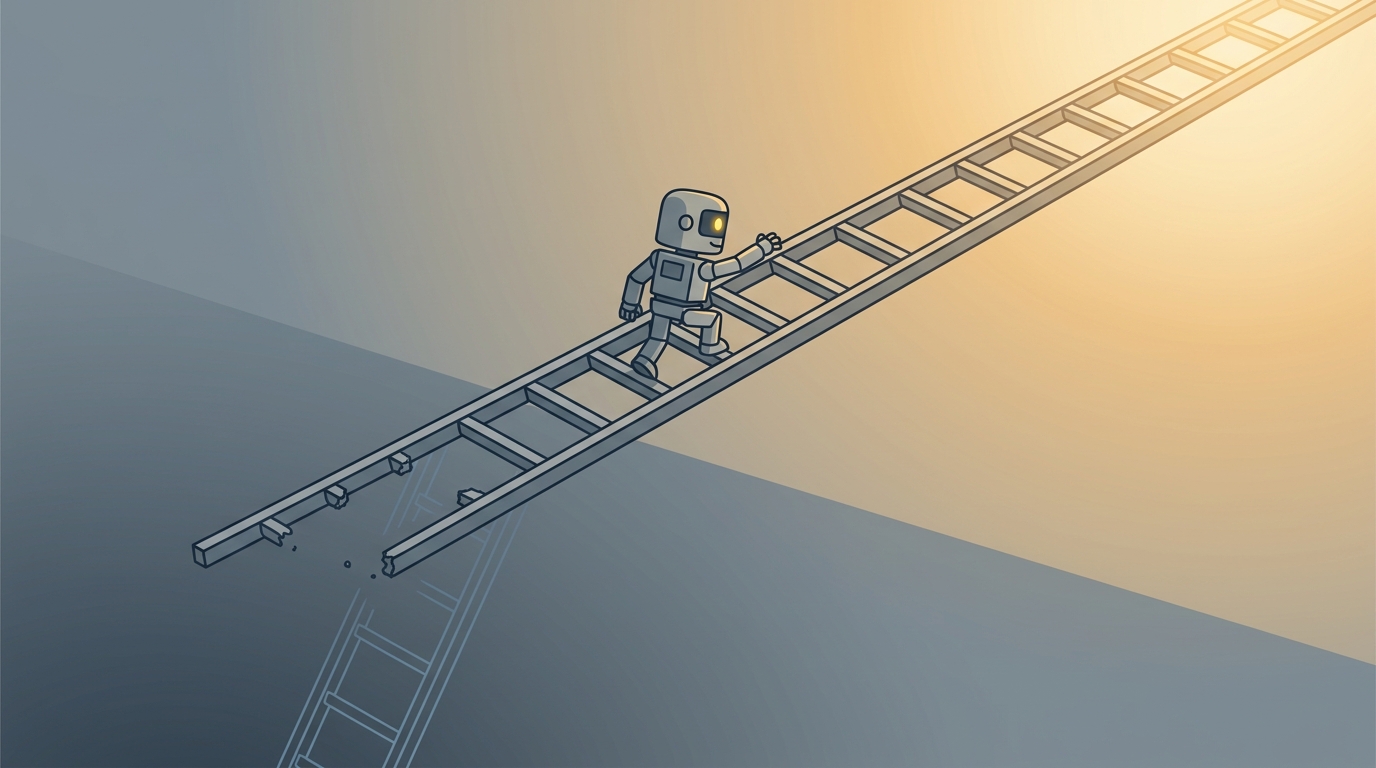
Most conversations about AI are really about what AI can do. Can it write code, can it draw a picture, can it write your emails. That’s the wrong question. The interesting question is what it does to the bar for the people doing the work.
We’ve seen this before. The internet ran the same experiment on a different set of skills, and the shape of the outcome was the same. The floor dropped. The ceiling rose. Tools don’t remove skill; they relocate it.
The Floor and the Bar
When people say a skill got easier, they’re usually describing two different things at once.
There’s the floor: what it costs to produce something at all. A first result, a rough draft, a function that runs.
And there’s the bar: what it takes to be useful. Work that holds up, that someone will pay for or depend on.
Those two move together only by accident. Most of the time they move apart, and the gap between them is where all the interesting stuff happens.
Before the Internet
Before the internet, learning something new was pretty difficult. You could go to the library, which seldom had complete information about a given topic unless you were in a large city. Other resources were family, or friends of family. You could sometimes find someone with expertise in a subject, but they had to have the time and inclination to want to help you.
Learning something new was pretty hard. Learning something esoteric was very hard.
A lot of it came down to a willingness to experiment and practice. One way of looking at it is that it was pretty hard to learn anything, but it was a lot easier to know enough to get started with something as a profession or serious hobby.
Access wasn’t the skill. Practice was. It just happened that you couldn’t practice much without access, so the two were fused together. When information is scarce, the floor and the bar sit right next to each other, both high.
The First Time: The Internet
When the internet first started making an appearance, in the mid to late 90s, for a while it was pretty easy to be an “expert” - someone who knew more than average about a topic. It became easier to find resources, both written and personal, on almost anything.
If you were early, you got something for free. Not skill, exactly. Access. There was a window where the resources existed but hadn’t spread yet, and anyone standing in that window looked like an expert. Remember that window.
As the internet became pervasive, that particular edge went away. Anyone could look things up.
This changed things. It was easier to learn things, but knowing “enough” about a topic became harder. The same words as before, pointing at the opposite thing.
It still took (and will always take) experimentation and practice.
The floor for knowing something dropped, but the bar for being good enough was raised. Everyone had the same starting information now, so standing out took something the information didn’t contain.
The Second Time: AI
We’re watching the same thing happen with AI. The difference is which floor it drops.
Just a few years ago, “writing code” was a pretty high bar. Now it’s almost non-existent. Anyone can generate code.
But almost nobody can generate a working system. Where the bar has been raised is in development - knowing enough to design an application that not only works, but accounts for future development. This includes architecture, project management, and everything a demo leaves out: how it deploys, how it fails, who maintains it, and what it costs to keep running.
An AI will happily write you a function. It may not notice that it’s in the wrong module, or that the name hides what it actually does, or that the approach you asked for is a poor fit. It answers the question you asked, competently, and you can’t count on it to tell you that you asked the wrong one. Sometimes it will notice. That’s worse than never, because it teaches you to trust it. Knowing which question to ask is development. It’s the job now.
The same is true of art. Knowing how to draw something took years of practice. Now, drawing a complex picture is easy. Drawing well is still a skill - knowing about how to describe mood, perspective, level of detail. Knowing what to draw in the first place.
A comic strip makes the point better than anything else. It doesn’t need to be drawn well at all. Stick figures work. What’s hard is making it funny - the timing, the beat, the silent panel of setup before the punchline. AI can render a whole strip in seconds and it will not be funny, because the funny was never in the drawing. The floor was already at zero, so there was nothing for the tool to drop.
Ditto with writing, and for the same reason. AI produces clean prose about anything. It can’t tell you which sentence to cut, which detail makes a scene real, or what you actually think. It has no life to draw from and no opinion worth defending.
In every one of these cases, the work moved from doing to describing. You don’t render the picture anymore; you tell the tool what the picture should be. And describing is harder than it sounds. It draws on exactly the taste that the old practice was building all along. The tool didn’t remove the skill. It removed the part that let you fake it.
The Same Trick, Twice
People will tell you AI is different in kind from the internet. The internet only gave you information; AI does the work. That’s true about the tools. It isn’t true about what they do to people.
The internet devalued whole categories of skill. Knowing how to work a card catalog. Knowing which reference book held the answer. The one person in town who actually knew the topic. Real skill, all of it, and most of it went to near-zero. The internet didn’t remove the need for skill. It raised the bar.
So does AI. Same move, just faster, and across more domains at once.
The internet handed you the recipe. AI cooks the meal. Fine - but that asks the same question the internet already asked: if the tool does that part, what’s the new bar?
It’s knowing what the diners actually want.
And knowing what to ask the tool for is the same skill. You can’t specify a meal someone will enjoy if you don’t know their taste. An AI can produce a competent drawing of anything you describe. It can’t tell you which drawing matters. It can cook. It doesn’t know what they want. That answer comes from having been wrong in public enough times to build a feel for it, and no amount of generation replaces it.
The difference between AI and the internet is speed and reach, not kind. It moves the same way. The people who assume the bar vanished are the ones who will be surprised later.
Where the Skill Went
The practical version is short. If you’re only as good as the tool, you’re replaceable by the tool. The thing that isn’t replaceable is the judgment: knowing what to build, why it matters, and whether the result is good enough to ship.
That’s learnable. It’s just not learnable by looking it up. It comes from doing the work.
And none of this is free. When the floor drops, the entry rungs get crowded, and the signals that used to stand in for skill - the degree, the certificate, the years of service - stop carrying the weight they used to. People are going to have to learn new skills, and “learn new skills” is a lot easier to say than to do. That’s a conversation worth having on its own.
The internet had its window, and the window closed. AI has one open right now. If you’re standing in it, enjoy the free expert status while it lasts. Just don’t mistake the window for a skill. The window always closes, and it strands whoever built their whole identity inside it.
Summary
Tools don’t remove skill. They relocate it. The internet dropped the floor on knowledge; AI is dropping the floor on production. The shape is the same both times: the floor comes down, the ceiling goes up, and the thing at the top - practice, judgment, the willingness to be wrong and keep going - stays exactly where it always was.